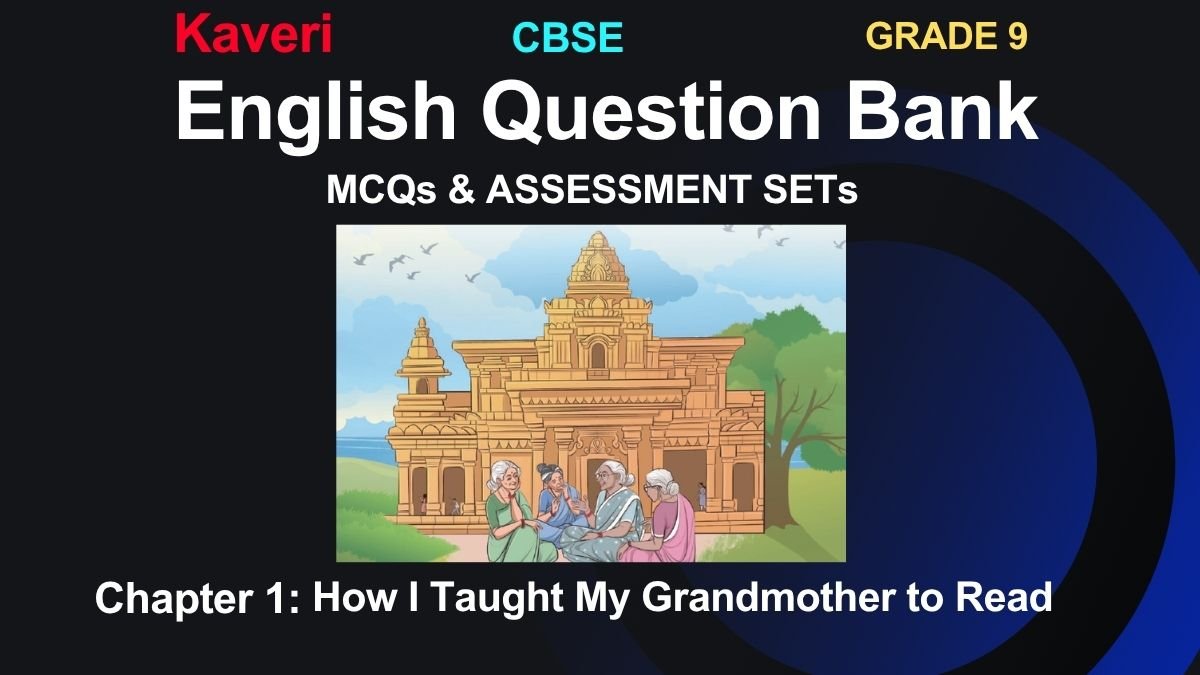
How I Taught My Grandmother to Read Question Bank Class 9 provides complete exam preparation for CBSE students. In this post, you will find topper notes, important questions, competency-based MCQs, HOTS questions, and practice sets to help you score high marks in exams. For complete chapter-wise resources, visit: Class 9 English Kaveri Complete Guide (All Chapters)
For complete textbook answers and detailed explanations, refer to: How I Taught My Grandmother to Read NCERT Solutions Class 9
Topper Notes for How I Taught My Grandmother to Read Class 9
These topper notes provide a quick and effective summary of How I Taught My Grandmother to Read for Class 9 CBSE students. They cover the theme, message, character sketch, key events, and important lines of the chapter in a concise and easy-to-revise format.
Theme
- Importance of education
- Lifelong learning
- Self-respect and independence
Message
- Learning has no age limit
- Education gives freedom and dignity
- Determination can overcome any obstacle
Character Sketch (Grandmother)
- Determined and hardworking
- Self-respecting and emotional
- Values education deeply
Key Events
- Grandmother listens to Kashi Yatre
- Feels helpless when narrator is away
- Decides to learn
- Becomes independent
- Touches narrator’s feet
Important Lines
- “For learning there is no age bar.”
- “What use is money when I cannot be independent?”
Revision Sheet (1-Day Preparation)
This How I Taught My Grandmother to Read Question Bank Class 9 helps students practise different types of questions for better exam preparation. This revision sheet helps students quickly revise the chapter in a short time. It includes key points and important questions to strengthen understanding before exams.
5 Must-Know Points
- Grandmother was illiterate
- Loved the story deeply
- Felt dependent and embarrassed
- Learned Kannada alphabet
- Achieved independence
5 Important Questions
- Why did the grandmother feel helpless?
- What inspired her to learn?
- Why did she touch the narrator’s feet?
- What message does the story convey?
- What is the role of Kashi Yatre?
Important Questions – How I Taught My Grandmother to Read Class 9
These important questions are designed as per the CBSE exam pattern. Practising them will help students improve answer writing and score better marks in exams.
- Explain the importance of education in the story.
- How does determination help the grandmother succeed?
- Why is education more important than wealth?
- Describe the role of the narrator as a teacher.
- What message does the story convey about lifelong learning?
These MCQs are part of the How I Taught My Grandmother to Read Question Bank Class 9 and follow the latest CBSE pattern.
How I Taught My Grandmother to Read Competency-Based MCQs
These MCQs follow the latest CBSE pattern and test understanding, application, and analytical skills. Practising them will help students improve accuracy and perform better in exams.
1. Assertion (A): The grandmother decided to learn reading.
Reason (R): She wanted to become independent.
A. Both A and R are true, and R is the correct explanation of A
B. Both A and R are true, but R is not the correct explanation of A
C. A is true, but R is false
D. A is false, but R is true
Answer: A
2. Grandmother felt helpless despite being wealthy. What does this show?
A. Money is the most important thing in life
B. Education is more important than wealth
C. Wealth can solve all problems
D. Old age creates problems
Answer: B
3. Why did the grandmother feel embarrassed?
A. She was poor
B. She could not read
C. She was ill
D. She was ignored
Answer: B
4. What is the central idea of the story?
A. Importance of travel
B. Importance of education
C. Value of money
D. Family traditions
Answer: B
5. Which word best describes the grandmother?
A. careless
B. lazy
C. determined
D. selfish
Answer: C
6. Assertion (A): The grandmother depended on the narrator.
Reason (R): She could not read the magazine herself.
A. Both A and R are true, and R is the correct explanation of A
B. Both A and R are true, but R is not the correct explanation of A
C. A is true, but R is false
D. A is false, but R is true
Answer: A
7. The grandmother repeatedly listened to the story Kashi Yatre. What does this suggest?
A. She had nothing else to do
B. She enjoyed listening and was emotionally connected
C. She was forced to listen
D. She disliked the story
Answer: B
8.Why did the grandmother insist on hearing the story regularly?
A. She wanted to pass time
B. She liked the narrator’s voice
C. She was deeply interested in the story
D. She had no work
Answer: C
9. Which idea is highlighted through the grandmother’s learning journey?
A. Age limits learning
B. Learning depends on wealth
C. Learning is possible at any age
D. Only children can learn
Answer: C
10. Which quality helped the grandmother succeed?
A. Laziness
B. Determination
C. Carelessness
D. Fear
Answer: B
11 What does the word “independent” mean in the story?
A. depending on others
B. self-reliant
C. confused
D. weak
Answer: B
12. If someone learns a new skill at an old age, it shows:
A. weakness
B. fear
C. determination
D. failure
Answer: C
13. What was the main reason for the grandmother’s decision to learn?
A. She was forced by the narrator
B. She felt embarrassed and dependent
C. She wanted to become famous
D. She had free time
Answer: B
14. What value is reflected when the grandmother touches the narrator’s feet?
A. Pride
B. Respect for knowledge
C. Anger
D. Fear
Answer: B
15. What would happen if the grandmother had not learned to read?
A. She would become rich
B. She would remain dependent
C. She would travel more
D. She would forget the story
Answer: B
16. What does the story mainly teach us?
A. Wealth is everything
B. Education gives independence
C. Age stops learning
D. Stories are unimportant
Answer: B
17. Why is the grandmother’s success inspiring?
A. She was young
B. She was rich
C. She overcame age and difficulty
D. She avoided work
Answer: C
18. What role does the narrator play in the story?
A. Observer
B. Teacher and supporter
C. Leader
D. Stranger
Answer: B
19. Which statement best expresses the message of the story?
A. Learning is only for children
B. Education is unnecessary
C. Determination leads to success
D. Money solves all problems
Answer: C
20. Why is the grandmother’s decision important?
A. It changes her life positively
B. It wastes her time
C. It creates problems
D. It has no impact
Answer: A
Explore all chapters here: Complete Class 9 English Kaveri Study Guide
Competency-Based Answers (CBSE Format)
These competency-based answers are framed according to the latest CBSE guidelines. They focus on clear explanation, proper structure, and appropriate word limits to help students write accurate and high-scoring answers in exams.
2 MARKS QUESTIONS
1. Why did the grandmother feel embarrassed?
The grandmother felt embarrassed because she was unable to read even at an advanced age. Although she was financially well-off, she had to depend on others to understand the magazine. This made her feel helpless and ashamed. Her self-respect prevented her from asking others for help, which increased her determination to become independent through learning.
2. What role did the story Kashi Yatre play in her life?
The story Kashi Yatre played a significant role in the grandmother’s life as it deeply interested and emotionally connected her. She identified herself with the protagonist and eagerly waited to know what happened next. When she could not read it herself, it made her realise her dependence, which inspired her to learn reading and writing.
3. What does the grandmother’s determination teach us?
The grandmother’s determination teaches us that strong willpower can help overcome any difficulty. Despite her old age, she decided to learn and worked hard to achieve her goal. Her example shows that learning has no age limit and that dedication and effort can help anyone succeed in life, no matter the challenges.
4. Why did the narrator feel surprised at her grandmother’s action?
The narrator felt surprised because her grandmother touched her feet, which is against traditional customs where elders are respected by younger ones. This unexpected act showed the grandmother’s respect for her as a teacher. It also highlighted the importance of knowledge over age, making the moment emotional and meaningful.
3 MARKS QUESTIONS
1. What role did the narrator play in the grandmother’s learning journey?
The narrator played a crucial role as a teacher and guide in the grandmother’s learning journey. She taught her the Kannada alphabet, helped her read and write, and encouraged her regularly. Her support and patience made the learning process easier and more effective. The narrator also motivated her grandmother to practise daily. Through her guidance, the grandmother gained confidence and achieved her goal of reading independently, showing the importance of proper guidance in learning.
2. How does the story show the importance of self-respect?
The story highlights self-respect through the grandmother’s feelings of embarrassment and dependence. Despite being wealthy, she feels ashamed because she cannot read. Her self-respect does not allow her to ask others for help. This motivates her to learn and become independent. Her determination to overcome this limitation shows that self-respect can inspire positive change. The story teaches that true dignity comes from independence and knowledge rather than material wealth.
3. What challenges did the grandmother face while learning?
The grandmother faced several challenges while learning. Her old age made it difficult to grasp new concepts quickly. She had never been to school, so she lacked basic knowledge of reading and writing. Additionally, managing household responsibilities made it harder for her to find time to study. However, her determination and hard work helped her overcome these challenges. She practised regularly and stayed focused, which eventually led to her success.
4. How does the story reflect the importance of determination?
The story clearly reflects the importance of determination through the grandmother’s journey. Despite being sixty-two years old, she decides to learn reading and writing. She sets a deadline and works hard every day to achieve her goal. Her strong willpower helps her overcome difficulties such as age and lack of education. Her success proves that determination plays a key role in achieving any goal, regardless of obstacles.
5 MARKS QUESTIONS
1. Explain how the story highlights the relationship between education and independence.
The story clearly establishes a strong connection between education and independence. The grandmother, despite being financially secure, feels helpless because she cannot read the story Kashi Yatre on her own. This shows that wealth cannot replace education. Her dependence on the narrator makes her realise the importance of being self-reliant. Determined to overcome this limitation, she decides to learn reading and writing. Through consistent effort and practice, she successfully becomes independent. Her transformation demonstrates that education empowers individuals by giving them confidence and freedom. It also highlights that true independence comes from knowledge, not material possessions. The story effectively conveys that education is essential for leading a dignified and self-reliant life.
2. Describe the transformation of the grandmother from dependence to independence.
The grandmother undergoes a remarkable transformation in the story. Initially, she is dependent on her granddaughter to read the weekly magazine. She feels embarrassed and helpless because she cannot read. This emotional struggle motivates her to take a bold decision to learn at the age of sixty-two. She works hard, practises daily, and shows great determination. Gradually, she becomes confident in her abilities. By the time of Dassara, she is able to read the novel independently. Her act of touching the narrator’s feet as a teacher shows her respect for education. This transformation highlights her growth from helplessness to self-reliance and proves that determination can bring positive change.
3. What message does the story convey about lifelong learning?
The story conveys a powerful message about lifelong learning. It shows that age is not a barrier to acquiring knowledge. The grandmother, despite being sixty-two years old, decides to learn reading and writing. Her determination proves that learning can happen at any stage of life. The story encourages individuals to overcome fear and hesitation and continue learning. It also highlights that education brings confidence, independence, and self-respect. Through the grandmother’s journey, the story inspires readers to believe in themselves and pursue knowledge throughout their lives.
4. How does the story reflect social issues related to education?
The story highlights important social issues, especially gender inequality in education. In the grandmother’s childhood, girls were not encouraged to attend school, which resulted in her illiteracy. This reflects the mindset of society at that time, where education for girls was not considered important. As a result, she remained dependent even in old age. However, her decision to learn later in life challenges this social norm. The story emphasises the need for equal educational opportunities for all. It also shows that education is essential for empowerment and independence, regardless of gender or age.
The following practice sets are included in this How I Taught My Grandmother to Read Question Bank Class 9 for complete exam preparation.
Class 9 English Chapter 1 Question Bank Practice Sets
These practice sets are designed to give students exam-like practice based on the latest CBSE pattern. Solving them regularly will improve understanding, time management, and answer-writing skills, helping students perform confidently in exams.
Practice Set 1
QUESTION BANK
ASSESSMENT SET 1
Class: IX
Chapter 1: How I Taught My Grandmother to Read
Marks: 25 Time: 1 hour
I. Extract-Based Questions
1. Read the extract and answer the questions that follow: (5✕1=5)
When I was a girl of about twelve, I used to stay in a village in north Karnataka with my grandparents. Those days, the transport system was not very good, so we used to get the morning paper only in the afternoon. The weekly magazine used to come one day late. All of us would wait eagerly for the bus, which used to come with the papers, weekly magazines and the post. At that time, Triveni was a very popular writer in the Kannada language. Her stories usually dealt with complex psychological problems in the lives of ordinary people and were always very interesting. My grandmother, Krishtakka, never went to school so she could not read.
(i) Complete the sentence with the correct option.
The phrase “wait eagerly for the bus” shows that the family was
A. careless
B. excited
C. worried
D. confused
(ii) Choose the correct option:
The grandmother could not read because she was (educated/illiterate)
(iii) Identify the clue that shows poor transport facilities.
(iv) Which line shows the popularity of Triveni?
(v) Which of the following is NOT emphasised in the extract?
A. poor transport system
B. importance of reading
C. grandmother’s education
D. narrator’s school life
II. Answer the Following Questions . (7✕2=14)
1. Why did the family wait eagerly for the bus?
2. Why was Triveni popular among readers?
3. Why could the grandmother not read the magazine?
4. How did the narrator help her grandmother?
5. Why did the grandmother like the story of Kashi Yatre?
6. What did the grandmother do after listening to the story?
7. What does the extract tell us about village life?
III Writing. (6✕1=6)
9. Write a letter to the Editor of a local newspaper highlighting the need to reduce excessive use of mobile phones among students. Suggest measures to promote healthy study habits.
Practice Set 2
QUESTION BANK
ASSESSMENT SET 2
Class: IX
Chapter 1: How I Taught My Grandmother to Read
Marks: 25 Time: 1 hour
I. Extract-Based Questions (5✕1=5)
1. Read the extract and answer the questions that follow:
My grandmother, Krishtakka, never went to school so she could not read. Every Wednesday the magazine would come and I would read the next episode of this story to her. During that time she would forget all her work and listen with the greatest concentration. Later, she could repeat the entire text by heart. My grandmother too never went to Kashi, and she identified herself with the novel’s protagonist. So more than anybody else she was the one most interested in knowing what happened next in the story and used to insist that I read the serial out to her.
(i) What does the grandmother’s ability to repeat the text by heart suggest about her?
A. She had a strong memory and deep interest
B. She wanted to impress others
C. She did not understand the story
D. She was forced to listen
(ii) Why did the grandmother identify herself with the protagonist? (Choose the best option)
A. Both were wealthy
B. Both shared similar emotions and desires
C. Both were educated
D. Both lived in cities
(iii) What can be inferred about the importance of storytelling in the grandmother’s life?
(iv) How does the extract reflect the theme of emotional connection?
(v) Which idea is MOST strongly highlighted in this extract?
A. importance of travel
B. value of education
C. power of emotional attachment
D. role of children in families
II. Answer the Following Questions (7✕2=14)
1. How does the grandmother’s reaction to the story reflect her inner desires?
2. Why do you think the grandmother valued the story more than others?
3. What does the narrator’s initial lack of understanding about the debate suggest?
4. How does the story highlight the gap between generations?
5. Why was the grandmother deeply affected when she missed an episode?
6. What social issue is indirectly highlighted through the grandmother’s life?
7. How does the setting contribute to the overall meaning of the story?
III Writing (6✕1=6)
1. Write a letter to the Editor of a local newspaper highlighting the problem of misinformation on social media and its impact on students. Suggest measures to promote responsible digital behaviour.
Practice Set 3
QUESTION BANK
ASSESSMENT SET 3
Class: IX
Chapter 1: How I Taught My Grandmother to Read
Marks: 25 Time: 1 hour
I. Extract-Based Questions (6✕1=6)
Read the extract and answer the questions that follow:
“I have decided I want to learn the Kannada alphabet from tomorrow onwards. I will work very hard. I will keep Saraswati Puja day during Dassara as the deadline. That day I should be able to read a novel on my own. I want to be independent.”
I saw the determination on her face. Yet I laughed at her.
“Avva, at this age of sixty-two you want to learn the alphabet?…”
Childishly I made fun of the old lady. But she just smiled.
“For a good cause if you are determined, you can overcome any obstacle… For learning there is no age bar.”
(i) Choose the correct option:
The grandmother’s desire to learn shows her
A. fear
B. determination
C. anger
D. confusion
(ii) Fill in the blank:
The grandmother wanted to learn in order to become __.
(iii) What does the narrator’s laughter reveal about her thinking?
(iv) Which line shows the grandmother’s strong willpower?
(v) Which theme is BEST highlighted in the extract?
A. family conflict
B. value of money
C. lifelong learning
D. childhood memories
(vi) Choose the most appropriate option:
Assertion (A): The grandmother decided to learn the alphabet.
Reason (R): She wanted to become independent and not depend on others.
A. Both A and R are true, and R is the correct explanation of A
B. Both A and R are true, but R is not the correct explanation of A
C. A is true, but R is false
D. A is false, but R is true
II. Answer the Following Questions (6✕2=12)
1. Why did the grandmother feel helpless despite being well-off?
2. Why did the grandmother set a deadline for herself?
3. How did the narrator initially react to her grandmother’s decision and why?
4. What qualities of the grandmother are reflected in this part of the story?
5. Why did the grandmother touch the narrator’s feet?
6. What message does the story convey about learning?
III Writing (7✕1=7)
1. Write a letter to the Editor of a local newspaper highlighting the importance of digital literacy among senior citizens. Suggest measures to help them become independent in today’s digital world.
Practice Set 4
QUESTION BANK
ASSESSMENT SET 4
Class: IX
Chapter 1: How I Taught My Grandmother to Read
Marks: 25 Time: 1 hour
I. Extract-Based Questions (6✕1=6)
1. Read the extract and answer the questions that follow:
Yes, I need your help. You know when you were away, Karmaveera came as usual. I opened the magazine. I saw the picture that accompanies the story of Kashi Yatre and I could not understand anything that was written. Many times I rubbed my hands over the pages wishing I could understand what was written, but I knew it was not possible. If only I was educated enough. I waited eagerly for you to return. I even thought of going to the village and asking you to read for me. I could have asked somebody here, but I was too embarrassed. I felt very dependent and helpless. We are well-off, but what use is money when I cannot be independent?
(i) Choose the correct option:
The grandmother felt helpless, mainly because she
A. was poor
B. was unwell
C. could not read
D. lived alone
(ii) Fill in the blank:
The grandmother felt embarrassed because she did not want to __ on others.
(iii) What does the line “what use is money…” suggest about her thinking?
(iv) Which phrase shows her strong desire to learn?
(v) Which theme is BEST reflected in the extract?
A. importance of wealth
B. value of independence
C. fear of society
D. childhood memories
(vi) Choose the most appropriate option:
Assertion (A): The grandmother did not ask others to read for her.
Reason (R): She felt embarrassed and wanted to be independent.
A. Both A and R are true, and R is the correct explanation of A
B. Both A and R are true, but R is not the correct explanation of A
C. A is true, but R is false
D. A is false, but R is true
II. Answer the Following Questions (6✕2=12)
1. Why did the grandmother feel that money was useless without education?
2. What does the grandmother’s embarrassment reveal about her character?
3. How does this extract highlight the importance of education?
4. Why did the grandmother wait eagerly for the narrator?
5. What emotional state is reflected in the grandmother’s words?
6. How does this situation become a turning point in the story?
III Writing (7✕1=7)
1. Write a letter to the Editor of a local newspaper highlighting the importance of reducing plastic use among students. Suggest practical steps schools and students can take.
Practice Set 5
QUESTION BANK
ASSESSMENT SET 5
Class: IX
Chapter 1: How I Taught My Grandmother to Read
Marks: 25 Time: 1 hour
I. Extract-Based Questions (6✕1=6)
1. Read the extract and answer the questions that follow:
The Dassara festival came as usual. Secretly I bought Kashi Yatre which had been published as a novel by that time. My grandmother called me to the puja place and made me sit on a stool. She gave me a gift of frock material. Then she did something unusual. She bent down and touched my feet. I was surprised and taken aback because elders never touch the feet of youngsters. We always touch the feet of elders and teachers as a mark of respect. She said she was touching the feet of a teacher, not her granddaughter. She added that a teacher should always be respected, irrespective of age or gender. I then realised that she had achieved her goal of reading independently and felt truly proud of her success.
(i) Choose the correct option:
The grandmother touched the narrator’s feet to show
A. fear
B. respect
C. confusion
D. regret
(ii) Fill in the blank:
The narrator was surprised because elders usually __ the feet of youngsters.
(iii) What does the grandmother’s action reveal about her values?
(iv) Which phrase indicates that the narrator felt shocked?
(v) Which theme is BEST reflected in the extract?
A. family tradition
B. importance of festivals
C. respect for teachers and education
D. childhood memories
(vi) Choose the most appropriate option:
Assertion (A): The grandmother touched the narrator’s feet.
Reason (R): She respected her as a teacher who helped her become independent.
A. Both A and R are true, and R is the correct explanation of A
B. Both A and R are true, but R is not the correct explanation of A
C. A is true, but R is false
D. A is false, but R is true
II. Answer the Following Questions (6✕2=12)
1. Why was the narrator surprised by her grandmother’s action?
2. What does this incident teach us about the value of education?
3. How does the grandmother redefine the idea of respect in this extract?
4. What does the grandmother’s success reveal about her character?
5. Why is this moment considered the climax of the story?
6. What broader social message is conveyed through this extract?
III Writing (7✕1=7)
1. Write a letter to the Editor of a local newspaper highlighting the importance of time management among students in the digital age. Suggest ways to improve productivity and focus.
Exam Prediction Questions
These questions are highly expected in exams and help students focus on important themes and concepts.
- Explain the grandmother’s transformation
- Importance of determination
- Role of education in independence
- Social issue highlighted in the story
- How does the story reflect lifelong learning?
- Why is self-respect important in a grandmother’s life?
Common Mistakes Students Make
Avoid these common mistakes to improve answer quality and score better marks.
- Writing a summary instead of an answer
- Not giving examples from the text
- Ignoring keywords like “explain” or “analyse.”
- Writing irrelevant or lengthy answers
- Not following the proper word limit
For complete textbook answers and detailed explanations, refer to: How I Taught My Grandmother to Read NCERT Solutions Class 9
Explore all chapters and full study material here: Class 9 English Kaveri Complete Guide
This How I Taught My Grandmother to Read Question Bank Class 9 covers all important areas, including MCQs, notes, and practice sets.
Frequently Asked Questions (FAQs)
Q1. What is the main theme of “How I Taught My Grandmother to Read”?
Ans: The main theme of the story is the importance of education and lifelong learning. It highlights that learning has no age limit and can bring independence and confidence. The story also emphasizes self-respect and determination, showing how strong willpower helps individuals overcome challenges and become self-reliant, even at an advanced age.
Q2. Why did the grandmother want to learn reading?
Ans: The grandmother wanted to learn reading because she felt helpless and dependent on others when she could not read the story Kashi Yatre by herself. This made her realise the importance of education. She desired to become independent and self-reliant, which motivated her to learn the Kannada alphabet despite her old age.
Q3. What message does the story convey?
Ans: The story conveys that learning has no age limit and education is essential for independence and dignity. It teaches that determination and hard work can help overcome any obstacle. The grandmother’s journey inspires readers to value education and continue learning throughout life, regardless of age or circumstances.
Q4. Who was Triveni in the story?
Ans: Triveni was a well-known Kannada writer whose novel Kashi Yatre played an important role in the story. Her writing style was simple and engaging, which attracted many readers. The grandmother became emotionally connected to the story, and it ultimately inspired her to learn reading and become independent.
Q5. Why did the grandmother touch the narrator’s feet?
Ans: The grandmother touched the narrator’s feet as a mark of respect for her as a teacher. In Indian culture, teachers are given great respect regardless of age. This act showed her gratitude and recognition of the narrator’s role in teaching her to read, highlighting the importance of knowledge and learning.