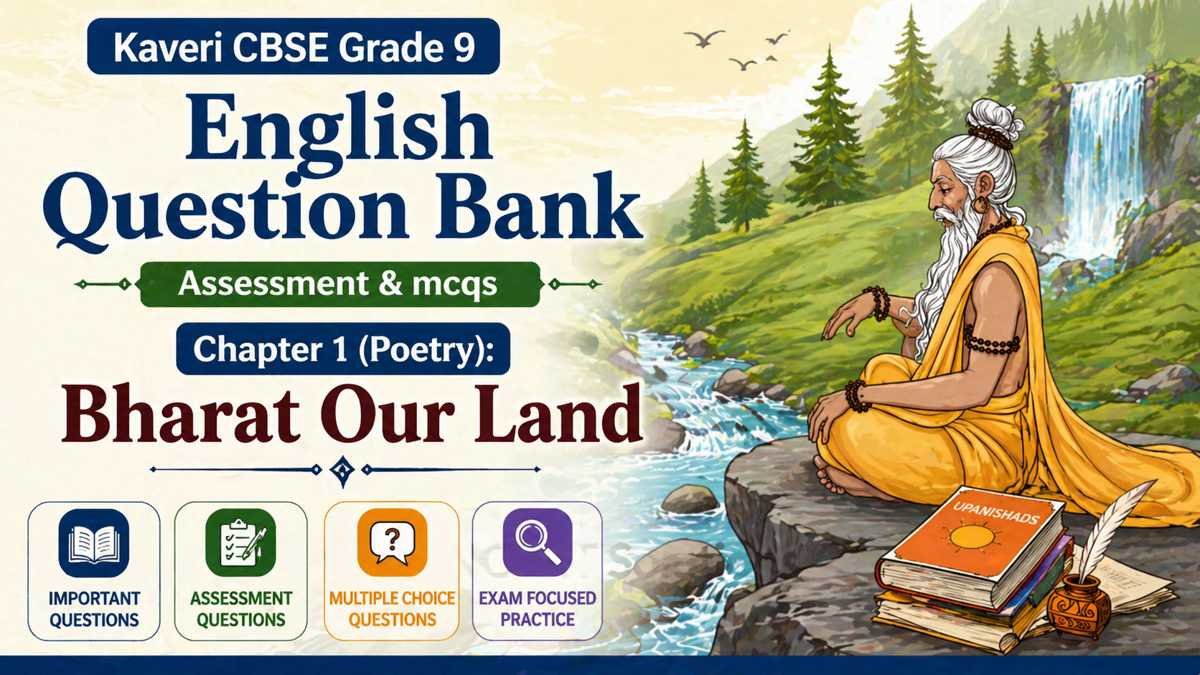
Bharat Our Land Question Bank Class 9 CBSE is a comprehensive study resource designed to help students understand the poem in a simple, exam-focused way. This chapter, written by Subramania Bharati, highlights India’s natural beauty, cultural richness, and deep spiritual heritage through powerful and expressive language.
In this question bank, students will find important model question Papers, detailed answers, and last-minute revision notes that are essential for scoring high marks in exams. The poem presents India as a “peerless” nation, combining elements of nature, knowledge, and tradition. For complete chapter-wise resources, visit: Class 9 English Kaveri Complete Guide (All Chapters)
For complete textbook answers and detailed explanations, refer to: Bharat Our Land NCERT Solutions Class 9
About the Poem
Poet
- Subramania Bharati
- A nationalist poet who wrote about freedom, pride, and Indian culture
Poem Type
- Ode → A poem of praise
- The poet praises India with deep admiration and emotion
Detailed Summary
Paragraph 1 (Nature & Knowledge)
- India is blessed with Himalaya (strength) and Ganga (purity)
- The Upanishads represent deep knowledge
- No other country matches India’s greatness
Paragraph 2 (Culture & Spirituality)
- Brave warriors protected the land
- Sages made it holy
- Music, traditions, and culture flourished
Paragraph 3 (Philosophy & History)
- India is the birthplace of Brahma-knowledge and Buddha’s teachings
- It has an ancient and rich history (hoary antiquity)
Conclusion
- India is peerless (incomparable)
- The poet calls everyone to praise and respect the nation
Theme / Central Idea (Detailed)
Main Theme
- India is a land of greatness in every aspect
Sub-Themes Explained
Patriotism
- Strong love and pride for the country
- Expressed through praise and admiration
Spirituality
- India is a centre of philosophy and religion
- Upanishads + Buddha = deep thinking
Natural Beauty
- Himalaya and Ganga show nature’s richness
Cultural Heritage
- Warriors + sages + music = rich tradition
Refrain
Line
“She’s peerless, let’s praise her!”
Why Important
- Highlights main idea: India is unmatched
- Creates rhythm and emphasis
- Builds emotional pride
Symbolism
| Symbol | Meaning | Explanation |
|---|---|---|
| Himavant | Strength | Stability and power of India |
| Ganga | Purity | Life-giving and sacred |
| Upanishads | Wisdom | Deep philosophical knowledge |
| Warriors | Courage | Protection of nation |
| Sages | Spirituality | Moral and religious guidance |
| Golden Land | Prosperity | Richness and beauty |
Important Words
Vocabulary Bank
- Mighty : very powerful
- Generous : giving freely
- Sacred : holy
- Peerless : without equal
- Gallant : brave and noble
- Sanctified : made pure
- Divinest : heavenly
- Auspicious : lucky, positive
- Antiquity : ancient past
Exam Tip: Learn at least 5 words for scoring marks
Line-by-Line Meaning (Quick View)
Himavant
- Shows India’s strength and uniqueness
Ganga
- Symbol of purity and grace
Upanishads
- Represents deep knowledge
Warriors & Sages
- Strength + spirituality together
Buddha
- Peace, truth, and enlightenment
Literary Devices with Examples
1. Personification
Giving human qualities to non-living things
Line:
“She’s peerless, let’s praise her!”
Explanation:
- India is described as “she.”
- Treated like a person/mother
- Shows emotional connection and respect
2. Hyperbole
Exaggeration for emphasis
Line:
“There’s no equal anywhere on earth.”
Explanation:
- Exaggerates India’s greatness
- Not literally true, but used to highlight pride
Explore all chapters here: Complete Class 9 English Kaveri Study Guide
Bharat Our Land MCQ Bank Class 9 CBSE
Bharat Our Land MCQ Bank Class 9 CBSE offers chapter-wise multiple choice questions with answers for effective practice. Includes concept-based, competency, and assertion-reason MCQs to strengthen understanding and boost exam scores.
1. What does the ‘mighty Himavant’ represent?
A. Wealth
B. Strength
C. Culture
D. Religion
Answer: B
2. The Ganga is described as ‘generous’ because it:
A. is long
B. gives water and supports life
C. flows fast
D. is famous
Answer: B
3. What do the Upanishads symbolise?
A. War
B. Nature
C. Knowledge
D. Music
Answer: C
4. The word ‘peerless’ means:
A. ordinary
B. weak
C. incomparable
D. equal
Answer: C
5. ‘Hoary antiquity’ refers to:
A. modern time
B. future
C. ancient past
D. present
Answer: C
6. What is the tone of the poem?
A. Sad
B. Angry
C. Admiring
D. Humorous
Answer: C
7. “She’s peerless” is an example of:
A. Simile
B. Personification
C. Irony
D. Metaphor
Answer: B
8. “There’s no equal anywhere on earth” is:
A. Imagery
B. Hyperbole
C. Alliteration
D. Simile
Answer: B
9. “Which other river can match her grace?” is:
A. Statement
B. Rhetorical question
C. Exclamation
D. Comparison
Answer: B
10. “Sunny golden land” is an example of:
A. Irony
B. Alliteration
C. Hyperbole
D. Pun
Answer: B
11. Why does the poet mention both warriors and sages?
A. To compare them
B. To show balance of strength and wisdom
C. To criticise them
D. To show history only
Answer: B
12. What message does the poem convey?
A. India is weak
B. India is average
C. India is great and should be praised
D. India is modern only
Answer: C
13. If ‘Ganga’ represents purity, what do ‘sages’ represent?
A. Wealth
B. Knowledge and spirituality
C. Power
D. Politics
Answer: B
14. Why is India called ‘golden land’?
A. It has gold
B. It is hot
C. It is rich in culture and beauty
D. It is modern
Answer: C
15. What does repetition in the poem achieve?
A. Confusion
B. Rhythm and emphasis
C. Length
D. Humor
Answer: B
16. Assertion (A): India is called ‘peerless’.
Reason (R): It has unique natural and cultural richness.**
A. Both A and R are true, R explains A
B. Both true, but R not explanation
C. A true, R false
D. A false, R true
Answer: A
17. Assertion (A): The poet uses rhetorical questions.
Reason (R): To show doubt and confusion.**
A. Both true
B. Both false
C. A true, R false
D. A false, R true
Answer: C
18. Assertion (A): Ganga is described as generous.
Reason (R): It provides water and supports life.
A. Both true, R explains A
B. Both true, not explanation
C. A false, R true
D. A true, R false
Answer: A
19. Assertion (A): The poem is an ode.
Reason (R): It praises India with deep emotion.
A. Both true, R explains A
B. Both false
C. A true, R false
D. A false, R true
Answer: A
20. Assertion (A): The tone of the poem is critical.
Reason (R): The poet highlights problems in India.
A. Both true
B. Both false
C. A true, R false
D. A false, R false
Answer: B
For complete chapter-wise resources, visit: Class 9 English Kaveri Complete Guide (All Chapters)
2-Mark Questions
2-Mark Questions – Bharat Our Land Question Bank offers concise, exam-ready answers to help you master key concepts and score high.
1. Why is India called ‘peerless’ in the poem?
India is called ‘peerless’ because the poet sees it as unmatched in every aspect. It has majestic natural features like the Himalaya and the Ganga, deep spiritual wisdom through the Upanishads, and a rich cultural heritage shaped by sages and warriors. All these qualities make India unique and superior to other nations.
2. How do sages contribute to India’s greatness?
Sages contribute to India’s greatness by spreading knowledge, spirituality, and moral values. They have sanctified the land through their teachings, meditation, and wisdom. Their influence has guided people towards truth and righteousness. This strong spiritual foundation has made India respected and admired throughout history.
3. What does the Ganga symbolise in the poem?
The Ganga symbolises purity, grace, and generosity in the poem. It provides water for life, supports agriculture, and is considered sacred by people. Its smooth and continuous flow represents calmness and beauty. The poet uses the Ganga as a symbol of India’s nurturing and life-giving nature.
4. Why are the Upanishads important?
The Upanishads are important because they represent India’s deep philosophical and spiritual knowledge. They contain teachings about life, truth, and self-realisation. The poet highlights them to show that India is rich in wisdom and intellectual heritage. They make India unique as a centre of learning and enlightenment.
5. What is meant by ‘sunny golden land’?
The phrase ‘sunny golden land’ refers to India’s beauty, prosperity, and richness. It suggests a land full of brightness, warmth, and natural wealth. The word ‘golden’ symbolises value and glory, while ‘sunny’ reflects positivity. Together, they present India as a vibrant, prosperous, and attractive nation.
3-Mark Questions
3-Mark Questions – Bharat Our Land Question Bank provides structured, detailed answers to help you explain concepts clearly and score full marks.
1. How does the poet describe India’s natural beauty?
The poet describes India’s natural beauty through powerful images like the mighty Himalaya and the graceful Ganga. The Himalaya represents strength and grandeur, while the Ganga symbolises purity and life. These elements show that India is blessed with unique and magnificent natural features. The poet uses these examples to highlight the richness and beauty of the land. Through such descriptions, he creates a vivid image of India as a place of natural wonder, which contributes to its greatness and makes it incomparable to other countries.
2. Explain the importance of repetition in the poem.
Repetition plays an important role in the poem by emphasising the poet’s feelings of pride and admiration for India. The line “she’s peerless, let’s praise her” is repeated to reinforce the idea that India is unique and deserves appreciation. This repetition creates rhythm and makes the poem more musical and memorable. It also strengthens the emotional connection between the reader and the nation. By repeating this idea, the poet ensures that the central message of pride and respect for India remains clear and impactful.
3. How does the poem reflect India’s cultural heritage?
The poem reflects India’s cultural heritage by highlighting its rich traditions, values, and history. The poet mentions warriors who showed bravery and protected the land, and sages who spread knowledge and spirituality. He also refers to music and auspicious traditions, which represent cultural richness. The Upanishads and Buddha’s teachings show India’s deep philosophical roots. Together, these elements present India as a land of strong cultural identity and heritage. The poem celebrates this heritage and encourages readers to feel proud of their nation.
4. What message does the poet convey through the poem?
The poet conveys a strong message of patriotism and pride in the poem. He presents India as a land of great natural beauty, spiritual wisdom, and rich cultural heritage. By describing India as ‘peerless’, he emphasizes that it is unique and incomparable. The poem encourages people to respect, admire, and appreciate their country. It reminds readers of India’s glorious past and its valuable traditions. Overall, the poet urges everyone to feel proud of their nation and to honour its greatness with love and respect.
5. Justify the title “Bharat Our Land.”
The title “Bharat Our Land” is highly appropriate because the poem is a tribute to India’s greatness and uniqueness. The word “Bharat” reflects the nation’s identity, while “Our Land” creates a sense of belonging and emotional connection. Throughout the poem, the poet praises India’s natural beauty through the Himalaya and the Ganga, its spiritual wisdom through the Upanishads and Buddha’s teachings, and its rich cultural heritage shaped by sages and warriors. By calling India “peerless,” the poet emphasises that it is unmatched. Thus, the title perfectly captures the poet’s deep admiration, pride, and collective ownership of the nation.
5-Mark Questions
5-Mark Questions – Bharat Our Land Question Bank provides in-depth, well-structured answers to help you analyze concepts and achieve top scores.
1. How does the poem inspire values of patriotism and respect for one’s country?
The poem strongly promotes the values of patriotism and respect for one’s country by presenting India as a land of unmatched greatness. The poet highlights India’s natural beauty through the Himalaya and the Ganga, its spiritual depth through the Upanishads and Buddha’s teachings, and its cultural richness through warriors and sages. These elements create a sense of pride and admiration in the reader’s mind. The repeated line “she’s peerless, let’s praise her” encourages people to recognise and honour their nation. It also teaches us to value our heritage, traditions, and history. By portraying India as sacred and unique, the poem inspires individuals to develop love, respect, and responsibility towards their country. It reminds us that being proud of our nation and preserving its values is an important duty of every citizen.
2. How can the ideas presented in the poem be applied in today’s modern society?
The ideas presented in the poem remain highly relevant in today’s modern society. The poem emphasises the importance of cultural heritage, spirituality, and respect for nature. In today’s fast-paced world, people often forget their roots and traditions. The poem reminds us to stay connected to our culture and values. For example, the respect shown to rivers like the Ganga can inspire us to protect natural resources and the environment. The emphasis on knowledge from the Upanishads and teachings of Buddha encourages us to value wisdom, peace, and ethical living. The bravery of warriors and the wisdom of sages can guide us to balance strength with morality. By applying these ideas, we can build a society that respects its past while progressing towards the future with responsibility and awareness.
3. How does the poem help in building national identity among young readers?
The poem plays an important role in shaping national identity among young readers by creating awareness of India’s rich heritage and values. It introduces them to important symbols like the Himalaya, the Ganga, the Upanishads, and Buddha’s teachings. These elements help students understand what makes India unique and special. By describing India as ‘peerless’, the poet builds a sense of pride and belonging. The poem also connects physical features with cultural and spiritual values, helping readers see the country as a complete identity rather than just a geographical place. The mention of warriors and sages highlights both courage and wisdom, which are essential qualities for a strong nation. As a result, young readers develop respect for their country and feel motivated to contribute positively to its future.
4. Do you think the poet idealises India too much? Give your opinion with reasons.
Ans: The poet certainly presents an idealised image of India by focusing only on its strengths and greatness. He highlights natural beauty, spiritual wisdom, and cultural richness without mentioning any problems or challenges. However, this idealisation is intentional and serves a purpose. The poem is an ode, which means it is meant to praise and celebrate. By presenting India as ‘peerless’, the poet aims to inspire pride and unity among readers. While it may not show the complete reality, it helps in building a positive attitude towards the country. In my opinion, such idealisation is important, especially in literature, because it motivates people to value their heritage and strive to live up to these ideals. It encourages citizens to preserve and improve their nation rather than focus only on its flaws.
5. Compare the importance of nature and spirituality in the poem. Which do you think is more significant?
Ans: The poem presents both nature and spirituality as equally important aspects of India’s greatness. Natural elements like the Himalaya and the Ganga represent strength, beauty, and life-giving power. On the other hand, spirituality is shown through the Upanishads, Brahma-knowledge, and Buddha’s teachings, which represent wisdom, peace, and moral values. While nature provides physical support and sustenance, spirituality gives direction and meaning to life. In my opinion, spirituality is slightly more significant because it shapes human behaviour and values. Without wisdom and moral guidance, the benefits of nature may not be used properly. However, the poet skillfully combines both aspects to show that India’s greatness lies in the balance between natural richness and spiritual depth. Together, they make India truly unique and admirable.
For complete chapter-wise resources, visit: Class 9 English Kaveri Complete Guide (All Chapters)
Bharat Our Land Question Bank Practice Set
Bharat Our Land Question Bank Practice Set offers exam-style questions and answers for effective revision and confident exam preparation.
QUESTION BANK
ASSESSMENT SET 1
Class: IX
Chapter 1: (Poetry): Bharat Our Land
Marks: 25 Time: 1 hour
SECTION – A (Extract -Based Questions) 5 × 1 = 5
1. Read the extract and answer the questions that follow:
This sunny golden land is ours—she’s
peerless, let’s praise her!
Gallant warriors have lived here,
many a sage has sanctified this land.
The divinest music has been heard here,
and here all auspicious things are found.
(i) Complete the sentence.
The phrase ‘sunny golden land’ suggests the __ of India.
(ii) Choose the correct option to complete the sentence given below.
The word ‘peerless’ in the extract means __.
(i) ordinary
(ii) incomparable
(iii) weak
(iv) common
(iii) Why are the warriors described as ‘gallant’?
(iv) What does the line ‘many a sage has sanctified this land’ mean?
(v) Fill in the blank with the correct option from the words given in the brackets.
The poet describes music as ‘divinest’ to show its __ nature.
(ordinary/heavenly)
SECTION – B Answer the Following Questions 6 × 2 = 12
2. How does the poet describe India’s natural beauty in the poem? 2
3. What role do sages play in making India sacred? 2
4. Compare the importance of warriors and sages in building a nation’s identity. 2
5. Why does the poet repeatedly ask readers to praise India? 2
6. Imagine you are a tourist visiting India. Which feature described in the poem would impress you the most, and why? 2
SECTION – C WRITING
7. Write a paragraph (120words) on the topic: “A Visit to a Place of Natural Beauty that Inspired You.” 8
You should include:
- Reason for visiting
- Who you travel with
- Preparation for the journey
- Where you stayed
- Activities you did
- How the place inspired you
QUESTION BANK
ASSESSMENT SET 2
Class: IX
Chapter 1: (Poetry): Bharat Our Land
Marks: 25 Time: 1 hour
SECTION – A (Extract -Based Questions) 5 × 1 = 5
1. Read the extract and answer the questions that follow:
Here Brahma-knowledge has taken root,
and the Buddha preached his dhamma here.
Of hoary antiquity is Bharat,
she’s peerless, let’s praise her!
(i) Complete the sentence.
The phrase ‘taken root’ suggests that Brahma-knowledge has __________ in India.
(ii) Choose the correct option to complete the sentence given below.
The word ‘hoary antiquity’ refers to __________.
(i) modern progress
(ii) recent history
(iii) ancient past
(iv) future development
(iii) Why does the poet mention Buddha in the extract?
(iv) What does the word ‘dhamma’ refer to?
(v) Fill in the blank with the correct option from the words given in the brackets.
The poet describes Bharat as ‘peerless’ to show that it is __________ (ordinary/incomparable).
SECTION – B Answer the Following Questions 6 × 2 = 12
2. How does the poem highlight India’s spiritual richness?
3. What message does the poet convey through the mention of Brahma-knowledge?
4. How can ancient knowledge still be relevant in today’s modern world? Give two points.
5. If you were to promote India globally, which aspect from the poem would you highlight and why?
6. How does repetition in the poem strengthen its theme?
SECTION – C WRITING
7. Write a paragraph (120) on the topic: “A Visit to a Place of Historical Importance”
You should include:
- What you learned from the visit
- Why you visited the place
- Who you travelled with
- Preparation for the journey
- Where you stayed
- What activities you did
Bharat Our Land Question Bank: Most Important Questions
- Explain how the poet presents India as a ‘peerless’ nation
- Discuss the theme of patriotism in the poem
- How does the poet use nature (Himalaya, Ganga) to show India’s greatness?
- Explain the role of spirituality (Upanishads, Buddha) in the poem
- How does the poem reflect India’s cultural heritage?
- What is the impact of the refrain “she’s peerless, let’s praise her”?
- How does the poem combine strength (warriors) and wisdom (sages)?
Common Mistakes Students Make
Avoid these mistakes to improve answer quality and score full marks
- Writing only the summary instead of answering the question
- Not using keywords like peerless, antiquity, sacred
- Ignoring literary devices when asked
- Not giving examples from the poem lines
- Writing too long or irrelevant answers
- Not maintaining proper word limit (60/90/150 words)
For complete textbook answers and detailed explanations, refer to: How I Taught My Grandmother to Read NCERT Solutions Class 9
Explore all chapters and full study material here: Class 9 English Kaveri Complete Guide
This How I Taught My Grandmother to Read Question Bank Class 9 covers all important areas, including MCQs, notes, and practice sets.
FAQs – Bharat Our Land Class 9 CBSE
1. What is the central idea of “Bharat Our Land”?
The central idea of the poem is that India is a peerless nation with rich natural beauty, deep spiritual wisdom, and a strong cultural heritage. The poet praises India and encourages people to feel proud of their country.
2. Why does the poet describe India as ‘peerless’?
The poet calls India ‘peerless’ because it has unique features like the Himalaya, the Ganga, the Upanishads, and great spiritual teachings. These make India incomparable to any other country.
3. What role do the Himalaya and Ganga play in the poem?
The Himalaya represents strength and grandeur, while the Ganga symbolises purity and life-giving power. Together, they highlight India’s natural beauty and greatness.
4. How does the poem reflect India’s cultural and spiritual heritage?
The poem mentions sages, warriors, Upanishads, and Buddha, showing India’s rich traditions, wisdom, and values. It highlights the country’s deep spiritual and cultural roots.
5. Why is the refrain “she’s peerless, let’s praise her” important?
The refrain emphasises that India is unique and deserves admiration. It creates rhythm, strengthens the poem’s message, and builds a strong feeling of patriotism.